

If someone asks ChatGPT to recommend a plumber in St. Louis, or asks Google’s AI Overview what the best local coffee shop is, will it mention your business?
For most small business owners, the honest answer is: they have no idea. And that’s a real problem, because the way people search is changing fast. More people are asking AI assistants directly instead of scrolling through search results, and those AI systems don’t read a website the same way Google does.
You can have a beautifully designed site, solid Google rankings, and still be completely invisible to ChatGPT, Google’s AI Overviews, and the AI shopping agents that are starting to book appointments and compare products on a customer’s behalf.
Here’s why that gap exists, and what actually determines whether AI systems can find, read, and recommend your business.
What “AI visibility” actually means
AI visibility is whether tools like ChatGPT, Google’s AI Overviews, and AI shopping agents can find, read, and accurately understand your business, separate from whether your website ranks well on Google.
These are two different systems checking two different things.
Traditional SEO is largely about ranking: keywords, backlinks, page authority, the signals that determine your position in a list of blue links. AI visibility is about something more basic: can an AI system even access your content, and once it does, can it clearly tell what your business does, sells, or offers?
A site can rank on page one of Google and still fail this second test. That happens when:
- AI crawlers like GPTBot, ClaudeBot, or PerplexityBot are blocked in the site’s robots.txt file
- The page has no structured data, so an AI system has to guess at basic facts like business type, services, or pricing
- Content is written in vague, persuasive language (“the best experience in town”) instead of clear, factual statements an AI can confidently quote
- The page structure is disorganized, making it hard for any system, human or AI, to tell what’s actually important
This matters because AI-powered search is no longer a niche behavior. More people are asking ChatGPT or Google’s AI Overview a direct question instead of clicking through a list of search results, and getting an answer without ever visiting a website. If an AI system can’t understand your business, it simply won’t mention you, no matter how well you rank in traditional search.
The technical signals AI systems check
AI systems evaluate a handful of specific, checkable things when they crawl a website. Most business owners have never heard of any of them, which is exactly why so many sites fail silently.
Crawler access
Before an AI system can read your site at all, it has to be allowed in. Every website has a robots.txt file that tells crawlers which parts of the site they can access. Some sites, often without realizing it, block AI crawlers specifically, GPTBot (OpenAI), ClaudeBot (Anthropic), and PerplexityBot are the three worth checking for by name. If any of these are blocked, that AI system cannot see your site at all, not partially, not with reduced ranking, completely invisible.
Structured data
Structured data, also called schema markup, is a standardized format that tells search engines and AI systems exactly what they’re looking at: this is a business, here’s its name, here’s what it sells, here’s its hours. Without it, an AI system has to infer these facts from unstructured text, which it often gets wrong or skips entirely. Adding basic schema (Organization, LocalBusiness, or Product, depending on the business type) is one of the highest-impact, lowest-effort fixes available.
Clean content structure
AI systems rely heavily on heading structure, the H1, H2, H3 tags, to understand how a page is organized. A page should have exactly one H1 (the main topic) and a logical hierarchy underneath it. Pages that skip levels, jump from an H1 straight to an H3, or have multiple H1s competing for attention, make it much harder for an AI system to extract a clear outline of the content.
Site speed and basic technical health
Slow-loading pages, broken links, and missing SSL certificates all get deprioritized, not just by Google, but by AI crawlers too. These are foundational, if a crawler times out trying to load your site, none of the content quality matters.
FAQ content
Direct question-and-answer content is one of the clearest signals AI systems use to extract quotable answers. A well-written FAQ section, especially one that answers the actual questions customers ask, gives AI systems ready-made, accurate material to pull from when someone asks about your business.
Title tags and meta descriptions
These still matter, not just for how your site displays in search results, but because they’re often the first thing an AI system reads to understand what a page is about. A title that’s too long, too vague, or missing entirely leaves AI systems guessing.
None of these require a developer or a redesign. They’re technical, but they’re fixable, often in an afternoon, once you know exactly what’s missing.
A real example
Earlier this year, we ran this exact type of audit on a handful of real small business websites, an ecommerce boutique, a local retailer, a service business, all built on modern platforms like Shopify, Square Online, WordPress and Wix. The results were a useful reality check.
One boutique’s site had zero structured data anywhere. Nothing telling AI systems what the business sold, what category its products fell into, or even confirming it was a business at all. Visually, the site looked polished and modern. To an AI system reading the raw page, it was close to meaningless.
Another site had a title tag and meta description that were completely empty, left blank, likely from a template that was never finished. That’s not a ranking penalty, that’s a business showing up with no title at all in search results, and no usable summary for an AI system to reference.
A third site had duplicate H1 tags on the same page, two competing “main headlines,” which made it genuinely ambiguous what the page was actually about, to a human skimming it, and especially to an AI system trying to extract a clear structure.
None of these were bad businesses or poorly designed websites. They were simply built for how customers searched five years ago, not for how AI systems read a page today. Each of these issues was fixable in under an hour once identified, the hard part was knowing they existed in the first place.
That’s the exact gap this kind of audit is built to catch.
What to actually do about it
You don’t need a developer or a full site rebuild to fix most of this. Here’s where to start, roughly in order of effort versus impact.
Check your robots.txt first. This is a five-minute check and the highest-stakes fix on this list, since a blocked crawler means total invisibility, not a minor penalty. Look for Disallow: / under any User-agent line mentioning GPTBot, ClaudeBot, or PerplexityBot. If you find one, remove it.
Add basic structured data. Most modern website platforms (Shopify, Square Online, WordPress with an SEO plugin) can add basic schema with minimal setup, sometimes just a checkbox or plugin install. You don’t need every schema type, Organization or LocalBusiness covers the basics for most small businesses.
Fix your title tags and meta descriptions. Keep titles between 30-60 characters and descriptions between 120-160 characters. Make sure every page actually has both filled in, an empty one is worse than an imperfect one.
Clean up your heading structure. Every page should have exactly one H1. Skim your site’s key pages and check that headings flow logically underneath it, without skipping from H1 straight to H3 or H4.
Write an FAQ section with real questions. Not generic filler, the actual questions customers ask you. This single addition is one of the clearest wins for AI visibility.
Recheck periodically. These things drift, a plugin update, a theme change, or a new page can quietly reintroduce a problem that was already fixed.
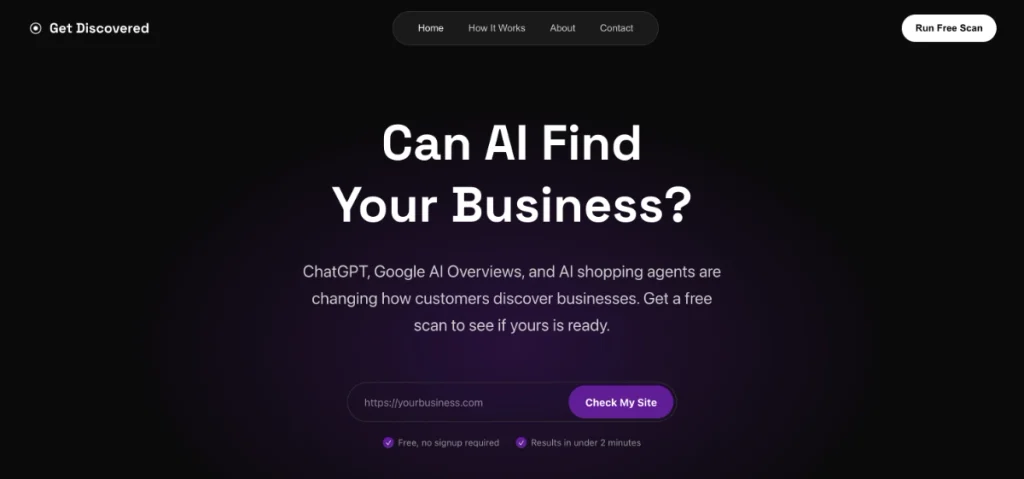
If you want to see exactly where your own site stands on these specific signals, that’s the entire reason we built GetDiscovered, a free scan that checks all of this automatically and explains what it finds in plain language.
SEO got your business found on Google. AI visibility is what gets you found by ChatGPT, AI Overviews, and the AI shopping agents that are becoming a real part of how people discover and choose businesses.
The good news is that most of these fixes are small, technical, and genuinely within reach without a full redesign. The hard part is usually just knowing what to check.
If you’re curious where your own site stands, run a free scan and see exactly what AI systems see when they look at your business, and what’s worth fixing first.
